


- ADAM rates a business on four pillars: AI, Digital, Automation, Measurement. Equally necessary, not equally weighted.
- Each pillar sits on one of five levels: Reactive, Aware, Capable, Strategic, Optimized. One level per pillar, no averaging.
- The four ratings collapse into a single 4×5 matrix on one sheet. Read the lowest cell: that is your constraint.
- Fix the weakest pillar first, one level a quarter. Resources on the strongest return the least.
- Eight failure patterns recur across every business. The meta-pattern is optimizing the pillar you already feel good about.
- The 90-day rollout is Diagnose, Lift, Verify. The full playbook is a free PDF.
Strategic decisions are rarely made. They are arrived at, through inertia, through whoever’s voice carries the room, through the path that requires the least disagreement. The decision that gets executed is usually the one that was easiest to talk about. A framework is that disagreement, written down in advance. Its only job is to make it harder for a business to lie to itself about which floor of the building is on fire. [1]
ADAM is four pillars and five levels. The pillars, AI, Digital, Automation, and Measurement, are not equally weighted. They are equally necessary. A business strong on three and weak on one is not most of the way there. It is fragile in exactly the dimension nobody is watching, and the failures it produces are predictable. The model is small on purpose: a framework large enough to describe everything ends up describing nothing. The whole of it is four pillars, five levels, eight named failure patterns, and a 90-day rollout of one pillar by one level, and nothing more.
01The four pillars
Every business runs on AI, Digital, Automation, and Measurement, not by choice, by gravity. Someone is using a model in a browser tab. Some workflow is automated, however badly. Some metric is being looked at, however selectively. The pillars describe what is already happening. The framework asks how well, how owned, how visible.
AI, the capability layer
Where intelligence enters the work, through prompts, models, and agents. It moves through three stages: assistive (it surfaces options a human picks), augmentative (it completes work a human signs off on), agentic (it executes multi-step work with bounded autonomy). Most teams operate at assistive and call it agentic.
CapabilityDigital, the platform
The floor the rest sits on: strategy, channels, and data infrastructure as one engine, or a folder of subscriptions that share a logo on the procurement page. Ownership is how many tools you bought. Fluency is how deeply the people inside use them. The gap between the two is where most budget quietly evaporates.
PlatformAutomation, the orchestration layer
The connective tissue that turns capability and tools into work that happens without anyone touching it. It is the only pillar where every well-built piece earns interest forever, and the only one where a silent failure routes wrong information for weeks before anyone notices. Automation that fails loudly is a feature. Automation that fails silently is a liability.
OrchestrationMeasurement, the feedback loop
The loop that closes the other three, in two halves: system performance (the numbers that fit a quarterly review) and organizational adoption (how fast the team stops needing a champion). This is where the human element lives. The hidden metric is decision lag, the time between data showing a problem and someone deciding about it.
FeedbackThe four are interdependent in a specific direction. Digital is the floor. Automation is the connective tissue between systems. AI is the capability that adds intelligence to that work. Measurement is the loop that decides whether any of it is helping. Each pillar earns interest only when the one beneath it can support its weight. A team that wants Level 4 AI on Level 2 Digital is buying a sports car with a flat tire, and the two A’s are not the same pillar: AI is where intelligence is added, automation is where work happens unattended. Conflating them is one of the cleanest ways to overspend on intelligence while underbuilding the rails.
02The five levels
Each pillar is rated on the same ladder. A business sits at one level per pillar, no averaging, no aspirational placement.
Reactive
Capability exists because someone bought it once. No owner, no review cadence, no roadmap. The pillar runs on whatever happens to happen, and breaks the same way.
Aware
An owner exists on the org chart. Reporting is sporadic and qualitative. Procurement happened. Adoption did not. Decisions still rely on senior intuition.
Capable
Workflows are documented, outputs are measured, and no single person carries the pillar. Failures become visible before they become expensive.
Strategic
The pillar feeds quarterly planning. Trade-offs are made on its data. Investment decisions cite it explicitly. A roadmap, not a hope.
Optimized
Improvement cycles are short and the pillar improves itself through structured experiments. The advantage is pace, and the pace compounds quarterly.
03The matrix
The whole framework collapses into one sheet. Mark one level per pillar, honestly, then read the lowest cell.
| Pillar | L1 Reactive | L2 Aware | L3 Capable | L4 Strategic | L5 Optimized |
|---|---|---|---|---|---|
| A · AI | Free tools, no policy, shadow use | Licenses bought, adoption sporadic | Use cases owned, outcomes measured per case | AI roadmap tied to goals, a lead in place | Agentic in production, self-improving loop |
| D · Digital | Tools bought once, email integrates | Power users carry the tools | Documented flows, adoption above threshold | Stack rationalized quarterly, data by design | Tool swaps painless, onboarding in days |
| A · Automation | Two flows from years ago, undocumented | A few flows, no monitoring | Inventory, owners, failure paths documented | Hours saved tracked, default is to automate | Self-healing flows, versioned like code |
| M · Measurement | Reports on request, decisions on instinct | Dashboards exist, action is sporadic | One number per pillar, owners named | Adoption tracked with performance | Decision lag in hours, predictive alerts live |
The highlighted cells are one illustrative profile, not a target. Here the lowest is Digital at Level 2, so Digital is the constraint, whatever the other three look like. Read your own lowest cell. That is your constraint, regardless of how strong the others are. Next quarter’s work is to lift that one pillar by exactly one level. Not two, not three pillars at once. The matrix is not a score to improve. It is an artifact you re-run every quarter, because once you lift the constraint, a different pillar becomes the new one.
The dashboard is not the work. It is the mirror the work has to face, and that mirror rarely shows four pillars of equal height.

Strengthen the weakest pillar first. Always. Resources allocated to the strongest pillar return the least. Resources allocated to the weakest return the most. That is the uncomfortable math, and the discipline is more uncomfortable still, because the weakest pillar is precisely the one the team least wants to look at. A dashboard with 30 metrics has none of them, and the meeting that reviews it becomes a recital. For each pillar there should be one number a leader would defend on a Monday morning, not five.
04Eight ways it fails
The failures are recurring shapes in the operational machinery. None is unique to a single business, and all are avoidable once named.
| Pattern | What it looks like |
|---|---|
| AI on broken digital | A model recommending answers on data nobody standardized. It inherits the floor below it. Fix the floor first. |
| Automation without measurement | A flow runs for a year. Nobody knows whether it saved hours or routed wrong. Both are equally probable. |
| The dashboard graveyard | Thirty metrics, four reviews a year, zero decisions changed. Decoration looking for a meeting. |
| The pilot that never ends | An experiment in its third quarter, still labeled “pilot.” Pilots that do not graduate are graveyards with branding. |
| return on investment (ROI) math without a baseline | A claim of saving 30%. Of what? Against when? Without a baseline the percentage is fiction with decimals. |
| Tooling without ownership | A platform is bought, the vendor implements, and six months later no one can answer “who owns this.” The tool decays. |
| The hero engineer | One person built every automation and is the bottleneck for any change. The runbook is the deliverable, not the migration. |
| Optimizing the wrong pillar | The meta-pattern. Resources flow to the strongest pillar where the team feels confident, while the weakest drags down the rest. |
Most of these are cheaper to prevent than to unwind. The automation stack that nobody can describe is the one that will surprise you, and the metric that never changes a decision is decoration with a login. The human element hides here too: adoption is the second-hardest thing to measure, because the honest answer is usually worse than leadership’s intuition, which is exactly why the team, not the tool, is what Measurement is really watching.
05A 90-day plan that survives reality
Three phases of 30 days. One pillar, lifted by exactly one level. The cadence is deliberately slow, because three quarters of disciplined single-pillar lifts outperform a year of simultaneous initiatives.
The framework does not choose the bold path. It chooses the next path, because boldness compounds only when discipline is in front of it. What ADAM refuses to do matters as much as what it measures. It does not measure strategy: that work lives upstream. It does not credit good people for trying. It reads what the operational machinery is actually producing, and refuses to flatter what it finds.
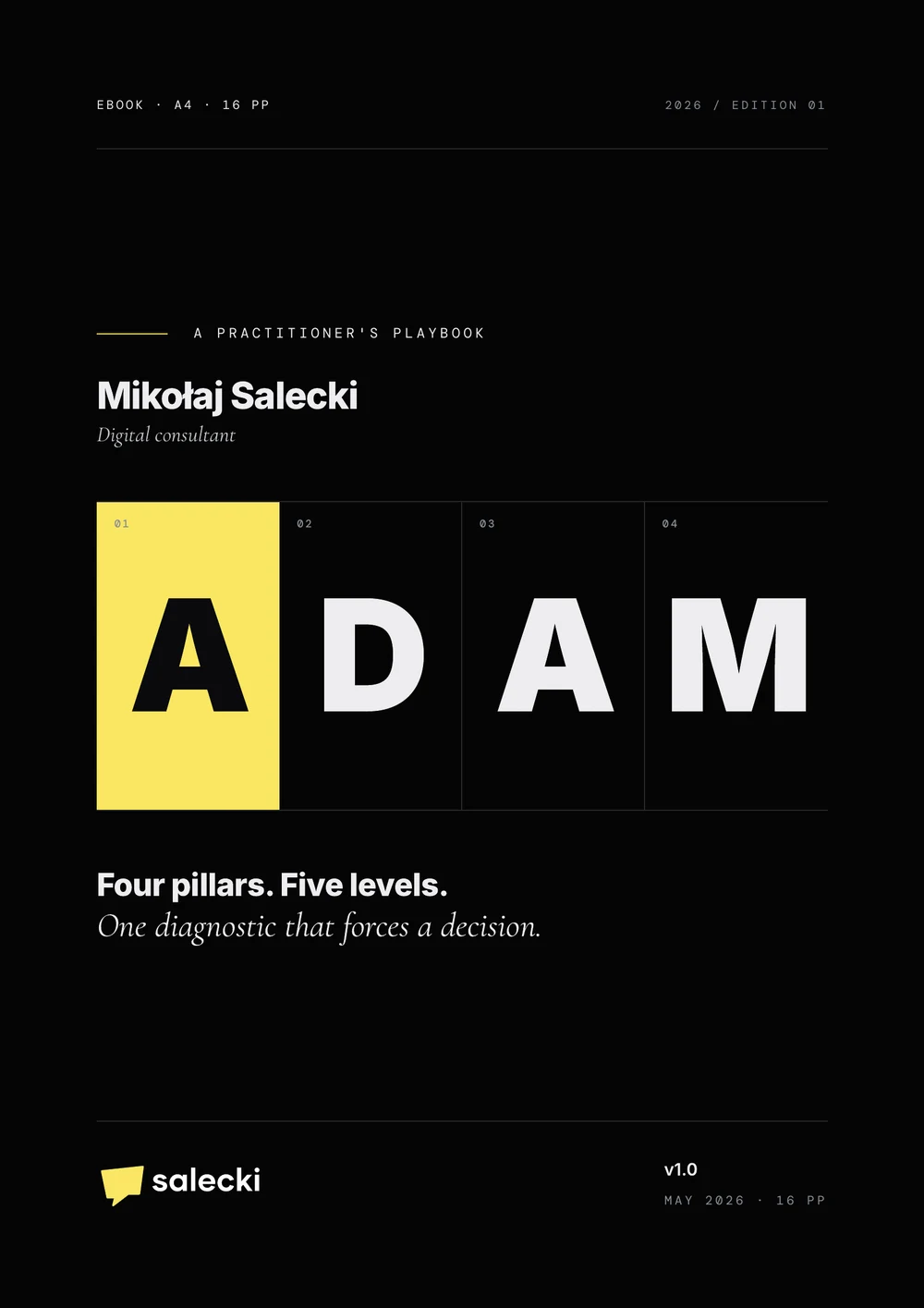
The ADAM Framework Playbook
Every pillar in depth, the five-level ladder, and the whole diagnostic in one place. Read it once end to end, then keep the matrix as a quarterly artifact.
- The 4×5 matrix, ready to plot your own business
- The level-up checklist for each pillar
- The eight failure patterns and the 90-day rollout
ADAM is small enough to be remembered, and to be acted on before the next quarter starts. That is the whole design. The businesses that pull ahead are not the ones with the strongest single pillar. They are the ones honest enough to plot themselves on the grid, read the lowest cell, and lift it, one level at a time, while everyone else pours another quarter into the pillar that already looks good. ADAM is the work of Mikołaj Salecki, a digital consultant. The full framework and the diagnostic live at salecki.digital/adam. [1]
Sources
ADAM is the author’s own framework, not a survey of the literature, so it carries a single canonical reference rather than a research bibliography. The framework’s home, the free playbook, and the way to work with the author all live in one place.
- Mikołaj Salecki · The ADAM Frameworkthe framework’s home page, playbook, and consulting context
Frequently asked questions
What is the ADAM framework?
A diagnostic for the operating model of a business, built on four pillars: AI, Digital, Automation, and Measurement. Each pillar is rated on the same five-level maturity ladder (Reactive, Aware, Capable, Strategic, Optimized). The four ratings collapse into a single 4×5 matrix on one sheet, and reading the lowest cell tells you which pillar is your constraint. The whole point is to force one honest decision per quarter, not to produce a score.
Why those four pillars, and why only four?
Every business already runs on all four, by gravity rather than choice: someone is using AI in a browser tab, some workflow is automated, and some metric is being looked at. Digital is the platform the rest sits on, Automation is the connective tissue between systems, AI is the capability that adds intelligence, and Measurement is the loop that decides whether any of it is helping. Four is the smallest set that maps both the technology and the feedback loop that judges it. The human element is not a separate pillar. It lives inside Measurement, as organizational adoption.
What do the five levels mean?
They are the same ladder for every pillar. Level 1 Reactive: tools exist because someone bought them once, no owner, no cadence. Level 2 Aware: an owner is named on the org chart but decisions still run on intuition. Level 3 Capable: workflows are documented and outputs are measured, no single person carries the pillar. Level 4 Strategic: the pillar feeds quarterly planning and investment decisions cite it explicitly. Level 5 Optimized: short improvement cycles, the pillar improves itself, and the advantage is pace.
How do I use the 4×5 matrix?
Mark one cell per pillar, honestly, the cell a stranger running the diagnostic would mark for you rather than the one you wish you were in. No averaging, no aspirational placement. Then read the lowest cell. That is your constraint, regardless of how strong the other three are. Next quarter’s work is to lift that one pillar by exactly one level, not two, and not three pillars at once.
Why fix the weakest pillar first?
Because a business strong on three pillars and weak on one is not 75% of the way there. It is fragile in exactly the dimension nobody is watching, and the failures it produces are predictable. Resources poured into the strongest pillar return the least. The same resources on the weakest return the most. The math is uncomfortable and the discipline more so, which is why most teams instead pour money into the pillar where they already feel confident.
What are the eight failure patterns?
Recurring shapes in the operational machinery, none unique to any one business: AI bolted on top of broken digital, automation without measurement, the dashboard graveyard (many metrics, zero decisions changed), the pilot that never ends, ROI math without a baseline, tooling without ownership, the hero engineer who is the single point of failure, and the meta-pattern, optimizing the wrong pillar. Each one is avoidable once it is named.
What is the 90-day rollout?
Three phases of 30 days. Diagnose: run the matrix honestly and find the one constraint, without starting to fix anything yet. Lift: move that single pillar up one level in 30 working days, declining every adjacent improvement that would dilute the focus. Verify: re-measure the one metric and confirm it actually moved before scaling, then re-run the matrix, because the constraint may have shifted to a new pillar. The cadence is deliberately slow: three quarters of disciplined single-pillar lifts beat a year of simultaneous initiatives.
Is the playbook free, and who wrote it?
Yes. The full 16-page ADAM Framework Playbook is a free PDF, covering the four pillars in depth, the five-level ladder, the 4×5 matrix you plot yourself on, the eight failure patterns, and the 90-day rollout. It was written by Mikołaj Salecki, a digital consultant. The framework’s home and the way to work with the author is salecki.digital/adam.

Mikołaj Salecki
Writes about media, tech, and AI business for people who actually run digital. Former agency lead. Skeptic of frameworks that read better than they perform.